Greetings, lovely readers - we hope you had a peaceful Christmas full of all the food, drink and other treaty things you could possibly want, as well as a happy start to the New Year. We've had ourselves a rest too, and while the return to a life of emails and spreadsheets might come as a shock after two weeks of being surgically attached to the sofa, I personally am raring to go. There'll be things to do, bands to write about and a flood of brilliant new albums (see our release calendar resource).

At this point in time when the year is still mostly a blank slate, in's and out's lists end up flying around the internet. They're good fun. As such, we thought we'd have a go at one of our own. We're going to have a lot to talk about in the next 12 months, and chances are there'll be some curveballs along the way.

Sean and I got into our 2026 predictions on the latest episode of the podcast, recorded at London's Shure Studios in late November. You can check that out on YouTube below (or search for "Drowned in Sound" on Apple or wherever you get your podcasts), and read on to find out what big themes might dominate 2026:

SPONSORED
CTA Image

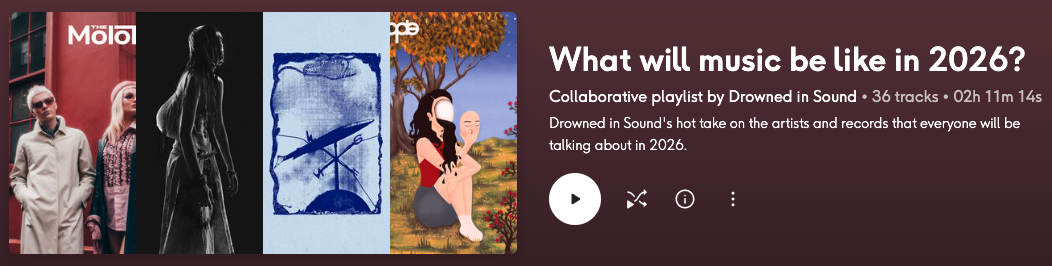
Drowned in Sound's podcast is presented in partnership with Qobuz - the service for music enthusiasts featuring high quality sound so that we can rediscover music. Listen to tracks from artists we think everyone will be talking about in 2026 and start your 30-day free trial of Qobuz.

Get a 30-day free trial

IN

Human curation

Once upon a time, it seemed unthinkable that simply being human could confer some sort of competitive advantage. Now, it offers a warmth and individuality that AI slop and algorithms can't help but lack and as such, human curation is more valuable than ever. The power could fall back into the hands of radio presenters, magazine editors, newsletter writers (yes, hello!) and social media personalities celebrating the music they love, as well as curators on more ethical streaming platforms like our friends at Qobuz, who now sponsor the podcast. To inversely quote Consequence, AI might not replace your cool friends who love music after all.
Music recommendations need heart - not AI
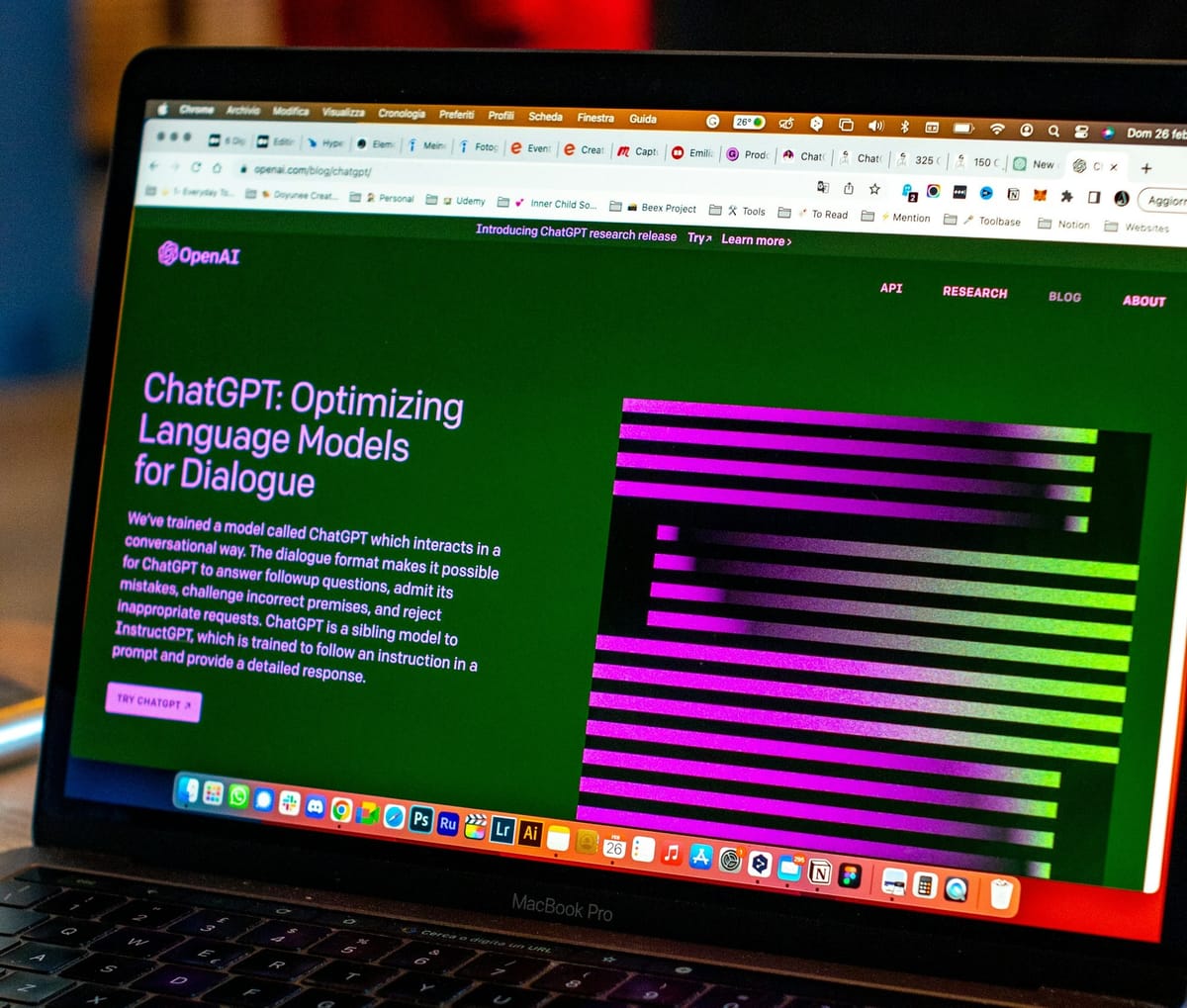
Spotify has partnered with Chat-GPT to bring users music recommendations. Politely (or not), no thanks…

Analogue media

This year, many of us are rejecting tech and embracing old-school media that can carry on working without a Wi-Fi connection. We crave what is tactile, real and actually owned by us instead of submitting to licensing, ad-slathered free access, and subscriptions.

Cue that print media boom there's been rumblings about (god, please), photos in albums taken on film or digital cameras and music on cassettes and CD. I heard from a man running a second-hand gadget stall in Spitalfields Market, east London, that sales of second iPods had soared - and as someone who's been a nerdy iPod devotee since I was a teenager, I'm here for it.

The joys of magazine-making with PROG Editor Jerry Ewing
How do you become a magazine editor that can put Kate Bush on the cover? And what’s it like running a genre-specific title in 2023? In a world where the digital age is rapidly redefining media, Sean Adams (@seaninsound) meets a titan of the magazine world, Jerry Ewing, editor of PROG magazine for a rare interview. From his roots starting a Marillion-inspired fanzine to being at the helm of genre-defining publications such as Classic Rock and Metal Hammer, Jerry’s journey is a testament to the enduring power of specialist knowledge and passion-driven journalism. Episode Highlights: The Genesis of a Genre Journalist: Jerry recounts the serendipitous moments that led him from crafting a fanzine to steering the course of iconic music magazines. The Art of Magazine-making: Delve into the craft of curating content for a niche audience, the evolution of magazines in the internet era, and the potential resurgence akin to vinyl’s comeback. Defining the Undefined: What is progressive rock? Jerry challenges the conventional confines, advocating for a broad, idea-driven definition that encompasses the innovative spirit of the genre. Adapting to the Beat of Change: The discussion turns to the seismic shifts in media consumption and the strategies for staying relevant in a landscape transformed by technology. The Human Touch: Jerry envisions a future where the human element is not just a feature but a proud declaration in magazine-making. Notable Quotes from Jerry Ewing: “Progressive music’s reach is quite wide... It’s the ideas and the approach to making music that sets them apart.” “Understanding your readers is crucial... Be comfortable with your readership, and they’ll feel comfortable with you.” “The editor guides the magazine... decides what goes in it, helps point the tone.” “For our readers, it’s the music that matters... They’re not interested in sex, drugs, and rock and roll.” “Communication between human beings is at the root of journalism.” Further Insights: From Court Jester to PROG: Jerry’s DIY beginnings and the transition from fanzine to professional journalism. The Inclusive Vision of Prog: Embracing a wide spectrum from prog metal to experimental indie, Jerry’s editorial direction is as diverse as the genre itself. The Editor’s Role: Setting the tone and creating a dialogue with music aficionados, Jerry’s editorial philosophy is about crafting a space for in-depth musical exploration. The Vinyl Moment for Magazines: Speculating on the tangible allure of print in the digital age, and the unique value it could regain. Links: PROG Magazine Jerry Ewing on Twitter Subscribe to Drowned in Sound on Substack

Imperfection

When AI can offer eerie, uncanny, soulless 'creations', human flaws gain a different significance. I'm expecting this to coincide with emerging trends in how music is produced, wherein glossy production is getting pushed aside in favour of music that sounds rawer and rougher. Forget the pristine - we're getting rough and ready this year.

'Calling in' instead of 'calling out'

At such a critical moment, infighting and moral purity slams the brakes on progress. While accountability and learning matters, perhaps those opportunities should come by means of communal invitation, polite suggestion, sentences with a question mark as opposed to an exclamation point. We need unity, not exclusion or division - and is it really better to nitpick the flaws of someone who generally means well as opposed to people genuinely enabling oppression?

Solidarity

Musicians came together against the genocide in Gaza and the far-right in 2025 and we can expect to see all this and more building momentum in 2026. This could expand to growing awareness around and noise made about the humanitarian crisis in Sudan, violence in Congo and in the last few days, Donald Trump's imperialist coup in Venezuela, which seems to be a breach of international law. Music has always been a force for good, and that's hardly going to change, but it will be amplified - and the conditions are ripe for some great political music too.

Hanging out in nature

Did you go for walks over Christmas? How about making it an all-year habit? Exploring nature is a tonic for the soul and the mind, bringing you out of your head and into the present, especially if you encounter some wildlife along the way. It's an act of self-care, an algorithm-defeating act of resistance and maybe even a galvanising act bringing you close to the beauty of nature and the vital need to preserve it. It's why it was the theme for our New Year's Day podcast, which you can listen to below.

Flying Rivers, Slipknot Swifts & Musical Frogs: Take This Podcast For A Walk In Nature
Season 5, Episode 1: What if swifts sound like Slipknot? What are flying rivers? And how do you give water a voice? This New Year special takes you backstage at EarthSonic Live, where over 3,000 people gathered at Manchester Museum to explore how music and nature sounds can help us reconnect with the planet and drive real climate action. Recorded across a single extraordinary day in November 2025, this episode captures conversations with conservationists protecting endangered species, climate activists working with Brian Eno and Billie Eilish, and Brazilian artists who travelled from Belém where the performed at COP30. From sampling frogs in the museum’s Vivarium with Japanese composer Hinako Omori to learning about the UK’s temperate rainforests (yes, really!), EarthSonic Live had it all. In the first episode of 2026, you’ll hear from RSPB conservationists Annabel Rushton and Roshni Parmar-Hill about why swifts are disappearing and what red squirrels tell us about biodiversity loss. Climate activist Tori Tsui shares how music became central to her campaigning. Hannah Overton from Warp Records explains more about the event. And we meet four members of FLOW, female artists from three continents to reflect on their journey to Belém for COP30, where they turned droughts, floods, and flying rivers into hip-hop, spoken word, and song. The Drowned in Sound podcast is presented in partnership with Qobuz, the pioneering high-quality music streaming and download platform for music enthusiasts and audiophiles. Each week we curate playlists on Qobuz, featuring our favourite records, artists, and the themes we explore on the show. Visit drownedinsound.org/playlists to discover new music in rich Hi-Res lossless quality and start your 30-day free trial of Qobuz at qobuz.com/dis. Continue the Conversation: Join the discussion on the Drowned in Sound forums and share your thoughts on music, nature, and climate action. Subscribe: Get the Drowned in Sound newsletter for weekly insights into music, culture, and building a fairer industry. Links & Resources: Tori Tsui - Climate activist and author of “It’s Not Just You: How to Navigate Eco-Anxiety and the Climate Crisis” EarthSonic Live - Event details and future dates Takkuuk - Inside Bicep’s Arctic Masterpiece (DiS article) Full Tori Tsui Interview - Climate justice and music with Brian Eno & Billie Eilish RSPB - Conservation and volunteering opportunities Wildhoarse Water - RSPB nature reserve in the Lake District with UK temperate rainforest In Place of War - Arts organization for social change Manchester Museum Vivarium - Home to the frogs sampled during workshops Sohini Alam - British-Bangladeshi composer and vocalist Keila - Brazilian singer from Gang do Eletro, FLOW artist Bebé Salvego - Brazilian jazz vocalist, FLOW artist Jaloo - Brazilian gender-fluid artist and producer, FLOW artist Hinako Omori - Japanese artist and composer Wellcome Trust - Event partner Arts Council England - Event partner Ableton - Event partner and workshop provider About the Host: Sean Adams is the founder of Drowned in Sound, an independent music publication championing underground and independent artists since 2000. Through the DiS podcast, newsletter, and community, Sean explores how to build a fairer, more sustainable music industry while supporting the artists and fans who make it meaningful. This episode was completely self-produced by Sean Adams, recorded on location at Manchester Museum. Thanks to Shure for providing the mics to record this special episode.

The £1 grassroots levy

Supporting grassroots venues will always be an in for us, but the fight to keep blood pumping through the UK's independent venue circuit could soon reach a brighter new chapter. The £1 grassroots levy could hopefully become a feature of more gig tickets as it comes closer to becoming industry standard, particularly in the wake of the Royal Albert Hall implementing it and The O2 bringing in a similar scheme.

The Music Venue Trust CEO Mark Davyd has warned this year's annual report, launched on 20th January, won't be cheery reading but emphasised that there is hope ahead nonetheless.  "I am confident enough to say this: We are closer now to a sustainable and viable grassroots music sector than we have been at any point since the pandemic hit," he wrote in his Substack on New Year's Day. "And that is not an accident. It is the accumulated result of thousands of decisions, arguments, compromises and acts of belief made by people who refused to let this stuff quietly disappear."

Greater transparency around AI

Not long ago, I saw a music video in which the description made clear that no AI was used in its production. This may well become more common in 2026 - and so it should. Greater transparency around where it has or hasn't been used is imperative particularly as the technology continues to develop in sophistication, and if the Government gets its priorities straight, there should be a legal obligation to label AI-generated or assisted music also.


OUT

Artists propping up fascism

Music is, and needs to be, a force for good. Singing the praises of a tyrant like Donald Trump [or insert any other far right politician] is certainly a way of becoming out of touch and laughing in the face of fans who will face the sharp end of his barbaric policies. Nicki Minaj, we're looking at you (even if you've deleted your Instagram during a mass unfollowing).

Being a slave to the algorithm

The tech rebellion I wrote about in the summer is continuing. Social media as we know it is rotting from the inside out. X is overrun with bots, trolls and creeps asking Grok to generate explicit photos of minors (which has proved such a concern that Ofcom is now involved). Instagram is censoring political posts and prioritising the content of influencers and advertisers over ordinary people. Then, there's the proliferation of AI slop.

It's telling that the writer Kyle Chayka proposed in an essay for the New Yorker that we could soon reach "posting zero" - this year, we're rejecting brain rot and embracing the joy of offline.

A summer of tech rebellion?
We’ve had a summer of rage - and one of the targets has been tech megacorps. Music is officially fighting back…

Spotify

One of 2025's biggest wildcard events was Spotify crashing and burning. Artists have left in their droves over Daniel Ek's investment in AI war drones, while the Spotify Unwrapped campaign called for a boycott of the platform over running advertisement for ICE recruitments and the increasing proliferation of AI music. The message is clear - Spotify is not the home for the ethically minded music fan (or those who really care about sound quality either). In 2026, we're choosing DSPs that care more about artists, the planet and the consumer (yes, we are talking about Qobuz).

Industry plant discourse

It's rare that music discourse is more boring and unproductive than when the internet squints at an emerging artist and decides if they're an 'industry plant'. What does it even mean? And who really wins from being so suspicious of success? Crucially, this approach fails because it focuses on individuals - genuinely innocent ones at that - rather than the need for systemic change. Dialogue on the inequality of opportunity in music is absolutely necessary, but in 2026, we need to zoom out and consider the bigger picture.

Trying to separate music from politics

We're looking at you, Eurovision. Music is a cultural and political battleground and always has been, making the idea that music and politics shouldn't coexist a futile, flimsy claim. The two cannot be separate, and why should they when artists have just as much of a right to express their own politics as anyone else?

Exploitative ticketing practices

The announcement late last year that it would become illegal to resell tickets above face value was long overdue. In the aftermath, there could be a reckoning on the way for the ticketing giants that have made buying gig tickets even more exhausting, complicated and expensive. Dynamic pricing has been subject to investigations by both the UK's Competitions And Marketing Authority (CMA) and the European Commission, as well as an official public consultation in the UK - could 2026 be the year it's finally banned? Meanwhile, the Ticketmaster-Live Nation monopoly has been pelted with lawsuit after lawsuit, opening the possibility for two of music's most powerful businesses to be broken up after 16 years.

The music industry's superfan obsession

As Sean and Hanna Kahlert from MIDiA Research discussed on the podcast recently, the idea of the superfan is quite nebulous. Is it measured by the length of time you've supported an artist? Did you have to be there when they were playing to no-one? What about more problematic definitions of money spent? When harnessed in the right way, with an emphasis on community and connection (shout out Hayley Williams' campaign for Ego Death At A Bachelorette Party), fan power is a beautiful thing. The same cannot be said of capitalising on those relationships in a transactional manner for profit - or exploiting fandom by churning out unnecessary amounts of vinyl variants.

Festivals powered by the military-industrial complex

First, it was the US Army. Then it was Barclays. After that, it was Superstruct/KKR. We can't forget SXSW's inaugural London edition artwashing David Cameron and Tony Blair, and letting the latter getting on his soapbox about AI. We've had two summers marked by protests against organisations with ties to weapons manufacturers, Israeli corporations operating in occupied territories and more. The message is clear - artists and fans will not stand for the artwashing of war and genocide. (By contrast, lovely independent festivals that platform great new talent and build community will always be in).

Doomerism

Sometimes, hope is hard to clutch onto. We live in a frightening world at the best of times where fascism looms large and progress could derail. We can't escape that reality, but neither should we surrender to it - and neither should we succumb to pessimism.

I hate doomerism. What are you supposed to do with it other than go back to bed and count down the seconds to the apocalypse? If we believe in doom, we risk creating a self-fulfilling prophecy and failing ourselves - to do so would be both a waste and a disgrace. Particularly when it comes to the climate crisis, there's even an argument that doomerism amounts to misinformation. There may have been an onslaught of troubling headlines from COP30 but crucially, we are not done.

I've heard it said that what is happening right now is the last gasp of an old order and a new one is slowly being birthed. I like this thought. Throughout the year, as people mobilised and fought back and strengthened their community building, I found a lot more reason to have hope and to keep my faith in humanity. In 2026, I hope this continues. It's a far more radical, galvanising, mind-strengthening act than giving up.


Did we forget anything? Argue it out in the comments.

Upcoming Album Releases (Jan 2026 - April 2026)
Your essential guide to forthcoming releases plus various mainstream releases.
The link has been copied!