

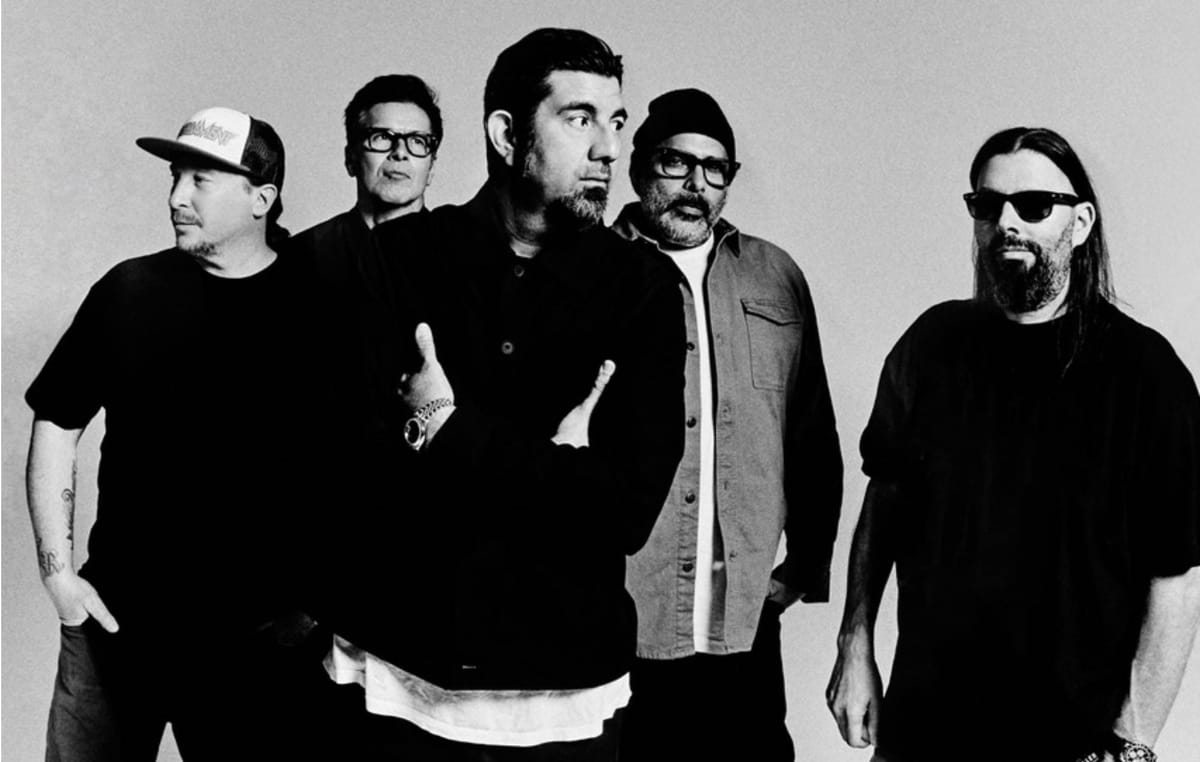
The girls treated it like prom: tops draping off shoulders, legs in fishnets, teetering around in platform boots. I saw them everywhere in The O2 last Friday night and I felt seen, because I was one of them. I was treating it like a capital-E event too, in an outfit too unseasonable for February – leather jacket, shorts, Docs, a smaller, tighter top than my usual boxy band shirts. Part of it was because I’d been having a grim week (correction, a grim month) and wanted to dress up and let loose, but above all, it was because tonight felt important. This was my first time seeing Deftones live.
This was an event where it felt like there was a cultural phenomenon happening right in front of you, close enough for you to reach out and touch. There’s something about the late-career Deftones surge that can restore your faith in culture and in humanity again, that in a time of AI slop and writing for the algorithm, authenticity and uniqueness always prevails.
My generation, Gen Z, has driven this massively. It’s filtered into a new generation of artists who have felt enlightened by their contrast between heaviness and lightness, the singularity of their sound, their forward-thinking fusion of metal with notes from other genres. The fans have powered it too. In a reader Q&A with The Guardian last year, someone asking vocalist Chino Moreno a question mentioned that the branch of HMV where he worked sells at least five copies of their landmark 1997 release Around The Fur a week to teenagers, more than, say, Nevermind or Rumours. It shows that, as time's passed, it's earned the status of classic - and the teenagers are learning well.
And of course, they want to take in the five members of Deftones in the flesh and they want to absorb the riffs thundering from the amps in real time. They want to hear those songs as a three-dimensional experience. All around me in the The O2 were young people likely also seeing this band for the first time live. So many of them were women of my age or younger, wanting to connect with a higher sort of culture by engaging with music that’s deemed classic. As the punters swanned out into the cold in the direction of North Greenwich station, the phrase rang in my head. Deftones is for the girls.
The obvious disclaimer: yes, technically every band is for everyone. I say this not meaning to be exclusionary but to consider who is being inclusionary. I don’t know if Moreno and his bandmates have ever thought about the gender demographics of their gigs or if they’ve changed at all. Nonetheless, there’s something I greatly value in a historically rather hyper-masculinised genre about seeing so many women of my generation at a metal event. It doesn’t happen by accident. In my job as a rock and metal writer for the likes of Kerrang! and Revolver, I've been to a lot of these shows, and gender wise, at some of them I'm outnumbered.
One of the significant things about Deftones is that they have always gone beyond metal’s basic aggressive tropes. The aggression is still present, conveyed in their mountainous riff work and low tunings, but it’s often suffused with something softer. Sometimes it’s with elements of shoegaze or the sultry tones of their influences like Prince or Sade, maybe it simply pours through in a gentle melody or the mere coolness of Moreno’s sensitive tenor. There’s something more sensitive about it, both in melody and lyrics. He’s mysterious and abstract but with a burning emotional core. And, infamously, he’s often quite horny.
As a woman, there’s a lot of space in here for me. There’s a grinding, sexual energy about ‘My Own Summer (Shove It)’ that could translate to ‘bad bitch energy’, if you like. The ethereal ‘Sextape’ is both more awestruck and more lovestruck than its title implies. And of course, there’s plenty of jagged edges along the way. It’s not to say women don’t like aggressive music, but there’s a difference between violence that feels universal and violence that feels gendered, or hypermasculinised. As we've all learned in recent times, violent feelings about the world, at the system or at the unfairness of life does not equate to violence against a specific group of people. Slipknot gigs are pretty egalitarian. They don't hate women; they hate everyone, misanthropy as opposed to misogyny.
I don’t think Deftones necessarily do this on purpose; it’s just who they are. Neither have they always been without flaws. The band themselves have admitted to retroactively feeling squirmy over the cover of Around The Fur, featuring a photo taken by skate photographer Rick Kosick where the camera practically stares down the cleavage of the woman, Lisa Hughes, who is the artwork’s subject.
Contrary to rumour, Hughes was not a groupie, neither did she not consent to the photo. “I found those articles, you know, about like [me allegedly] being a groupie and this and that. I was like, maybe I should just start a little page just about myself, and so people know that I’m Lisa." she told Jenkem in January 2026. "I’m just this awesome chick from Auburn, and I like to have fun. And there’s no groupie action going on here. Just me having a kick-ass time, you know."
Despite the strange, discomforting nature of the artwork, it's certainly not the most grossly sexualised image of a woman in metal artwork that I’ve seen. Of course, it's filtered through the male gaze, but it's not necessarily titillating. Hughes isn't posing, as such. I’m much more repulsed by, say, the woman on the cover of Bullet For My Valentine’s The Poison. Not just a sexualised woman, but a sexualised dead woman.
Speaking of dead women, a female corpse also appears in ‘Digital Bath’, a song that depicts the murder of a woman an electrified bathtub. It’s a chilling yet melodic centerpiece on 2000’s White Pony, insidiously delivered but sounding so lush that its meaning isn’t immediately obvious. It's entirely obvious that the meaning might not penetrate straight away to anyone listening and the real meaning unfolds when you dig deeper. The lack of overtness might be why it's evaded great levels of criticism.
Still, this isn’t enough to deter the women flooding into The O2. To some degree, there's a lot of gender-related cognitive dissonance we can deal with when it comes to the media we love, but that's another essay (Under My Thumb: Songs That Hate Women & The Women Who Love Them, edited by Rhian E. Jones and Eli Davies is a great read if this is an area of interest). Nonetheless, there’s a lot worse. Perhaps this is a low bar, but there’s never the sense that their music is trying to exclude me or tell me ‘This is not for you’. Quite the opposite.
I was reminded of this exclusionary feeling when I was listening to deathcore band Whitechapel, who I’d never been intensely familiar with, in preparation for a live review. They’re still playing live material from their 2007 debut The Somatic Defilement, a concept album about Jack the Ripper which describes the rape and murder of his victims in detail that’s nauseatingly graphic. (One song they play is called ‘Devirginisation Studies’, which says a lot).
Never is it applauded, but something about relying on violence against women for shock value, as if it’s the stuff of horror films, is quite disturbing to me. It’s aged poorly, and they could distance themselves from it, but the fact they still play it live doesn’t feel like a suitable decision to be making in 2026. The crowd still offered a hero’s welcome nonetheless. Maybe they hadn’t Googled the lyrics. I still ended up wondering, ‘Were you playing to any women back in 2007?’
In 2026, the gender balance in metal is finally seesawing to a more egalitarian point – metal is girlypop, didn’t you know? – and maybe the shifts occurring have also brought bands with large female fanbases back into the zeitgeist, or kept them there. The girls helped bring Deftones all new acclaim three decades deep into the career, especially as their incredible influence has now become tangible. On that note, between seeing those two bands, I’ve now begun developing a theory.
Anecdotally, I’ve noticed the gender balance at arena shows for rock and metal gigs tends to be much more even than at smaller shows. I noticed it even when I was 19 at my first Slipknot show. Even the presence of a woman on stage at a sticky-floored club show doesn’t guarantee there’ll be more women in the audience. I’m wondering if, to get beyond a certain size in metal, you have to get the girls on your side.
I thought about this earlier this month, while watching New Jersey symphonic deathcore band Lorna Shore – who Whitechapel were supporting - pack out London’s 10,000-capacity Alexandra Palace. It’s rare for bands of that extremity to play rooms so big, but they’ve done so by deepening the genre’s emotional reach, adding lush strings and conceptual, emotional narratives to the music. For example, their most recent album, last year’s I Feel The Everblack Festering Within Me, dealt with frontman Will Ramos' estrangement from his father and his family's history of dementia.
And, lo and behold, Lorna Shore have more women in their crowds than most bands of their ilk can dream of. I see this with other metal heavyweights too. Sleep Token have hooked in plenty of women, touched by the turbulent depths anonymous frontman Vessel’s lyrics go to, and they’re becoming one of the defining artists of their generation. Ironically, I’ve noticed that many of their most vehement detractors are male, with some suggesting online they find his emotional sensitivity threatening to their own fragile masculinity.
Then, we get – finally! – the slew of women-led bands breaking the glass ceiling getting into arenas. Look at Babymetal, Halestorm, and Spiritbox, the latter of whom has now earned three Grammy nominations and has just announced a UK and Europe headline tour with a bill full of bands featuring women (take a bow, Jinjer and Dying Wish).
Consciously or not, Deftones have had this knowledge all along. They've chosen the right time to ascend into the form of their lives, tighter, sharper and even more life-affirming than ever. They are a supernova again. I am thankful for them, for as I dashed back into The O2 as the opening chords of 'Be Quiet & Drive' built the tension under a sea of blue light - all to drop into a jaw-dropping detonation. I punched the sky. I'm not sure the opening of any gig has left me so overwhelmed with euphoria.
I’ll be back to watch them headline Outbreak London on 23rd August. I expect I’ll find the girls on the barrier.
Emma Wilkes is is the Newsletter Editor at Drowned in Sound and an occasional co-host on the Drowned in Sound podcast. She also writes for Kerrang!, Revolver, The Guardian, NME and more and has just announced her first book Queens Of Rock - pre-order here. You can follow her on Instagram here.