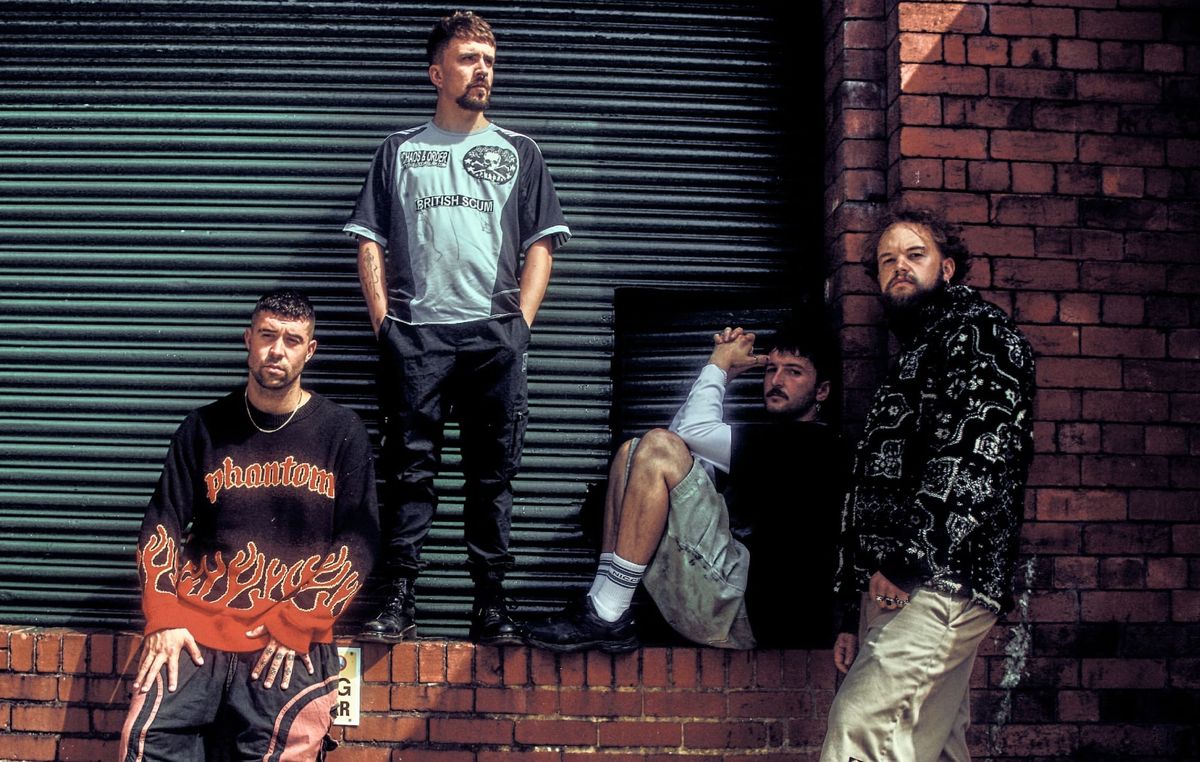
Last autumn, Maruja offered one of 2025's most electric breakout moments, vaulting between explosive fury, simmering tension and spiritual serenity on their expansive debut album Pain To Power.
Their message, of peace, connection and resistance, has been as vital as their chameleonic sound in which riffs collide with the leaping melodies of a saxophone. It's one of the most unique recipes around in modern guitar music.
Vocalist-guitarist Harry Wilkinson and saxophonist Joe Carroll called us from on tour in Porto, Portugal, to discuss the story so far, their fans' tattoos and the state of, well, everything...
Hey guys! What's it been like to digest the success of Pain To Power since it came out in September?
Joe: "Doing the shows definitely helps us realise how much of a deep impact it's having on people. The amount of people getting tattoos is blowing our heads off. Yesterday, this guy came up to me and Harry when we were outside, and he was like, 'Can you write down these lyrics from Look Down On Us?' Harry wrote them down. He's like, 'I'm gonna get it tattooed on my body in Harry's handwriting.' We're like, 'Fucking hell.' We walked into the venue with him, and then he was like, "Say hi to my mate.' He lifted up his shirt, and he had the Pain To Power logo on his arm It's just like, "'What on earth is going on?'"
Harry: "It's kind of dystopian seeing it all online, but it doesn't really feel real until you actually speak with people and get on the ground, play the shows, and see the impact that it has when we play the live shows. You see people singing every word, or bawling their eyes out, or throwing themselves headfirst into each other. It's a very like grounding thing to see at the live shows."
What do you think people have been connecting with the most on it?
Harry: "The album traverses through a lot of topics - addiction, mental health. obviously a quite strong political theme as well. I think that all of those topics are so prevalent in everybody's lives at the moment that it's hard to just pick one, really, because they're all kind of like a symptom of one another. There's a lot of anxiety stemming from the political state of the world and the economic state of the world, and that fuels people's addictions, and they all kind of go hand in hand with each other, because that's people's coping mechanisms.
"There's certain songs where I've seen people crying, and I've just held their hand as I'm doing the verse, and done the verse to them, and you can see how much it means to them. That's the biggest gift that we can give anybody - from us turning our pain into power, to then seeing that reflected in other people at the shows, is it's a very humbling thing."
What do you think an artist's role should be in such dystopian times as these?
Joe: "I heard Westside Cowboy talk about this really well recently, and they were saying that you've got to be aware of the context that you're making music in nowadays. You can't just be 'We're not a political band' and not touch on anything that's going on. When you go to a concert, you're there for emotional expression, purging your emotions and all those sorts of things. It's very much a part of the collective consciousness at the moment."
You end your shows on the line: "We wish you peace, prosperity and unity in these times of global oppression. Together we are stronger, please raise a fist for solidarity." Why is championing that sense of peace so important to you? It's a different way of meeting the anger of the current moment.
Harry: "A lot of the time you can't really control what happens in the world, but you can control how you react to it. I find that you can't really do anything in the world as well, unless you've kind of sorted yourself out a bit. Before [we play] 'The Invisible Man', we ask everybody to give each other a hug, because it's about mental health, specifically about a lot of friends that I've lost to mental health, and that's because they had no peace. They use drugs to find to escape to find spirituality and they lost themselves on the way and never really returned.
"This is no culture that is looking after its people's well-being, and if a culture isn't looking after its people's well-being, then what is the point of it? That's really what a government should be doing. Preaching for peace thing comes from a place of spiritual unrest that hangs in the cultural zeitgeist, and seeing all the war in all different places. We have a really bad economy, an uprising of fascism and a homelessness crisis, a failing NHS, and we're still one of the countries that are blessed comparatively to, Iran or Sudan or Ukraine, etc. etc. There's so many countries that are in such turmoil that it's really hard not to talk about peace, because I think generally most people just want to get on, and it's only really down to a few that have this insatiable thirst for power and money, and that is really kind of affecting the rest of us, but it takes peace and organization to actually bring that into fruition."
London's grassroots venues have afforded you a home away from home, particularly the Brixton Windmill. What makes the grassroots scene in the capital so special?
Joe: "We have a saying in the band - if a fish stinks, it stinks from the head. The Windmill doesn't stink, because it's headed up by a guy called Tim and his whole philosophy behind the Windmill, even though it's got this gravitas now, is that he champions bands in such a way, and he puts the money behind it. When we first did our show there, we played in a bill with four bands, and I think we got £200 and that is unheard of. The vast majority of support slots, you get £50 and that's been the standard for the last 30 years, but he makes sure all the bands are paid properly. That way of thinking is so rare nowadays, not going through a promoter. It's a real community that it's now got international acclaim, and it's just stemmed from one dude having the kind of right idea and a good taste of music.
"We come from Manchester, where there are promotion companies that are literally just stealing from bands, stealing from artists coming up. There are two promoters who have both single-handedly killed the Manchester scene just by taking advantage of artists that are coming up, charging loads for tickets, taking all the money, and then artists aren't able to feed back into their own craft, and they're not able to buy that next instrument or take the time of work. It's really sad and we the detrimental effect that has on musicians that are coming up, and then they can't sustain themselves, and it creates this whole elitist thing for artists that are coming up, and like it's only artists that are able to afford to sustain themselves because of their parents' money or support from a really stable family that allows them to make music,
"Having independent venues that are all about community gives people community in their own lives. It's a way you can really experience emotion and purge your own personal emotions. The sense of community in grassroots venues is just unlike anything else, really, and we owe everything to all the grassroots venues we've played throughout the years."
How does it feel to not just be headlining Bulletproof's inaugural edition, but to be its first ever headliners?
Harry: "It's a great privilege. It's a testament to our hard work as well, and it also shows that the message is going to the right people in the right places. What the festival stands for is reflective of our values as well; they're the spaces we want to be in. It's difficult not to kind of touch on on politics and stuff like that in the music, when really that's this huge collective shadow that hangs over everywhere, and especially with the rise of fascism and stuff, to be able to play a festival and headline the first day in line with such a morally kind of appetizing thing. It cements the fact that we're on the right path.
"The artist's job, as you were asking before, in my opinion is to reflect the ever changing face of culture, in whichever capacity that may be, and I believe that that's what we do in our band. Yet, to have that recognition and to be in the right place at the right time to help inspire people who are like-minded and open-minded, that's such a huge monumental thing for us. We want to try and help change the narrative of the cultural zeitgeist. We want to remind people that they're not alone. We want to try and bring the left and the centre closer together, you know. We want to try and talk about things that are really important.
"Every show before we play 'Look Down On Us' we say they try to blame the immigrants, but we know it's the billionaires not paying enough taxes, and then everybody screams. The right have used fear and hate to contour a lot of broken people, a lot of rejected people from society, and because obviously they have billionaire donors, they're able to take over social media, take over news platforms, newspapers. Then it's really up to artists and people on the left to try and do what they can to try and balance it out a little bit, because it's a very unfair battle at the moment. If we can try and help sway that narrative, then we feel like we're doing our job, and that gives us a lot of gratitude. This festival is a testament of that."
Maruja headline Bulletproof Festival at EartH in Hackney, east London, on Thursday 4th June. Sprints and Pussy Riot: Riot Days are headlining on Friday 5th and Saturday 6th respectively, with the line-up featuring the likes of CQ Wrestling, YAKKIE, CLT DRP, Alien Chicks, SNAYX, King No-One, Jools and more.
Listen to all the acts playing Bulletproof Festival with this week's DiS playlist powered by Qobuz - your neatly packaged starter pack to the line-up. Browse our playlist archive.
🎟️ If you fancy seeing these acts and joining us at Bulletproof, final tickets are available here.
Related reads
 Emma Wilkes
 Emma Wilkes