


By Emma Wilkes with additional reporting and infographics by Sean Adams
Live Nation has created a "climate of fear" in the UK live music industry, according to the House of Commons Business and Trade Committee.
They published a report on Sunday (24th May) indicating that Live Nation - the world's largest live entertainment company - meets the threshold for market dominance across multiple areas of the UK live music supply chain.
The committee's now calling for another investigation into Live Nation's business practices to take place before the end of the year.
Liam Byrne MP, Chair, House of Commons Business and Trade Committee said:
"What particularly alarmed the Committee was not just the scale of Live Nation's market position across promotion, venues, and ticketing, but the climate of fear we encountered during this inquiry.
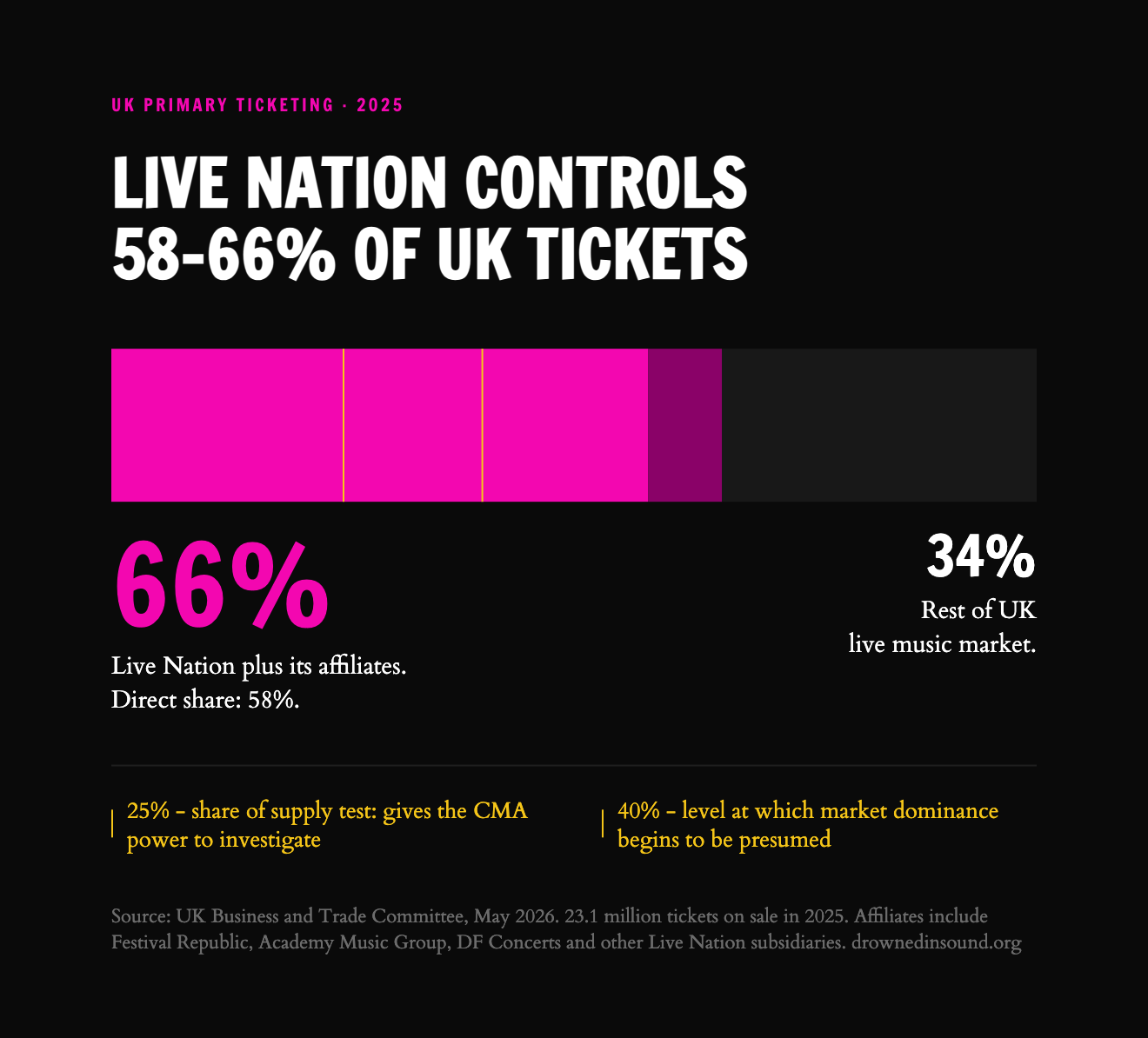
Yes, Live Nation directly controls 58% of UK primary ticket sales, rising to 66% once its affiliates are included.¹ Both figures sit well past the 25% share of supply test that triggers CMA jurisdiction, and the 40% level at which market dominance begins to be presumed, under UK competition law.
Which?'s analysis² of Pollstar data adds a third angle that adds more context to the sales: Live Nation itself promotes shows representing 53% of the total value of all UK tickets sold, with second-placed SJM Concerts at 23% of ticket revenues.
A Climate of Fear (and Loathing?)
It's also rather telling that among the 45 submissions given when the Committee called for written evidence, a "significant proportion" requested to submit anonymously or confidentially for fear of repercussions. "This in itself raises concerns about Live Nation's dominant and controlling market position," the report stated.
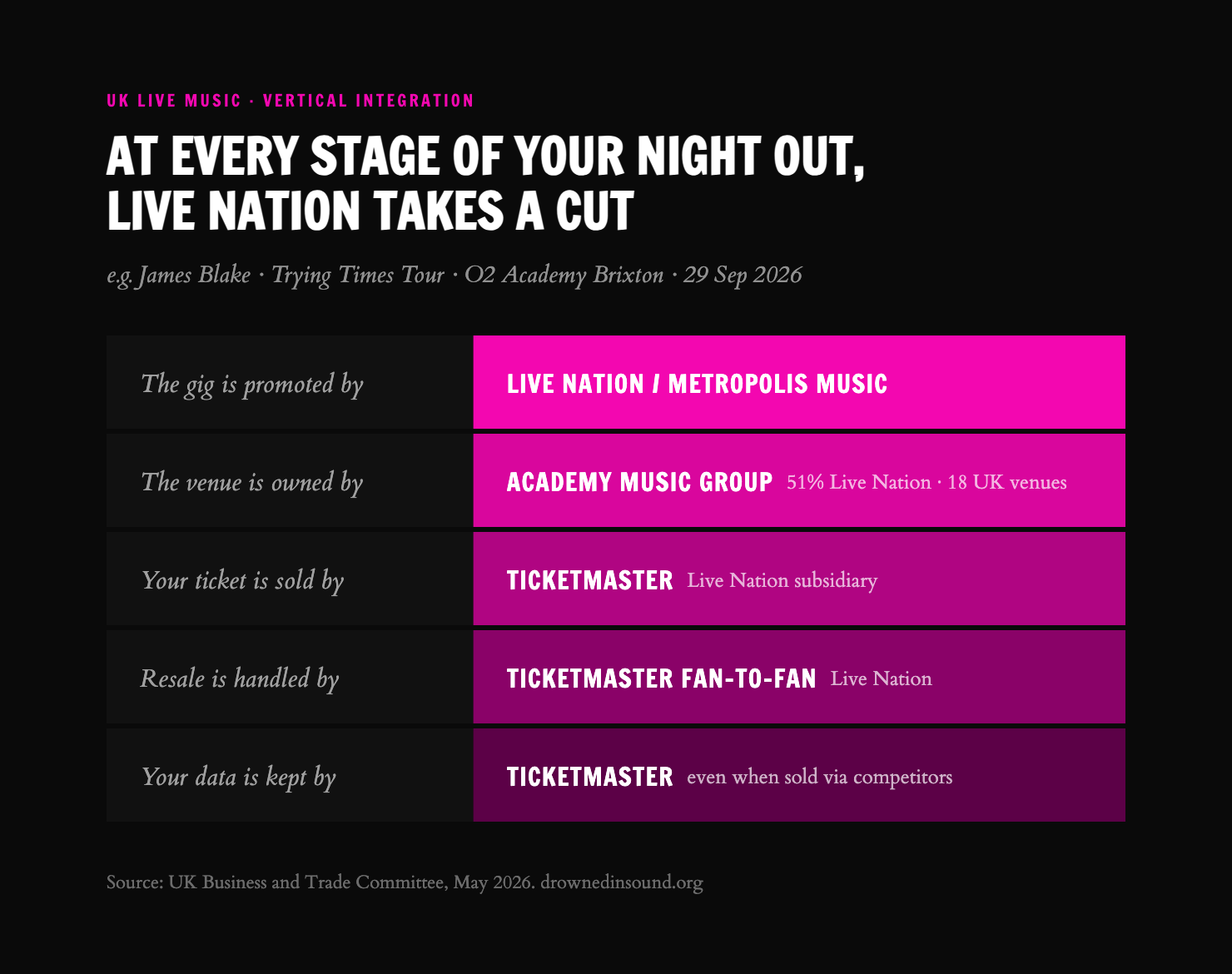
The dominance isn't only about ticketing. Live Nation operates 18 mid-size venues through Academy Music Group: the entire O2 Academy chain across Brixton, Shepherd's Bush, Glasgow, Newcastle, Leeds, Birmingham and beyond, plus the smaller Academy 2 rooms inside several of them.
Most of these buildings aren't owned outright; the operation runs through long-term contracts and integrated services.
However, at a Live Nation-promoted show, the ticket is sold by Ticketmaster (a Live Nation subsidiary), the resale options run through Ticketmaster Fan-to-Fan, and the customer data is retained by Ticketmaster even if the original ticket was bought through a competitor.
They make no secret of this. Live Nation's Executive President, Touring International Music, Phil Bowdery, appeared before the Committee on 24 June 2025 and confessed: "We are vertically integrated, as are most of our competitors."⁴ (Vertical integration, in this context, means one company owning multiple stages of the same supply chain: promotion, venue, ticketing, resale, customer data.)
Dean James, co-founder of the MAMA Group - one of the UK's largest live music companies before its sale - put the logic plainly: "If you don't play their venues, you don't play their festivals."³ And as we'll explain a sec, they have a major role in festivals too.
Vertical Insanity?!
The Committee's verdict on what this means at the checkout is direct. "The scale and scope of Live Nation's vertical integration, and their control of ticket sales, appear to have created an ecosystem that squeezes out competition," the report states, before adding "the upshot is that fans get a raw deal with high prices and few alternatives."
None of this was built quickly. There was a slow creep...
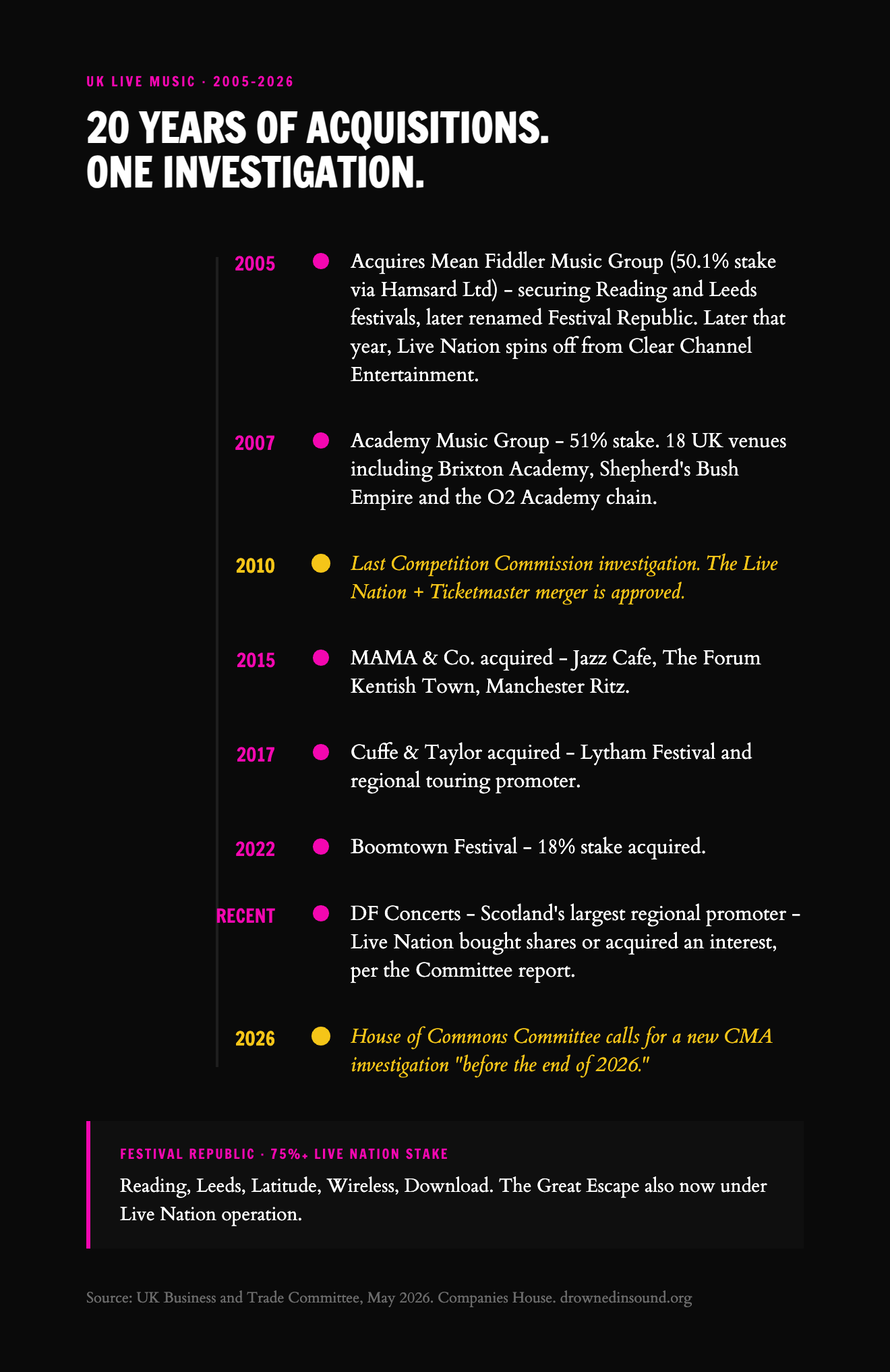
In April 2005, before it even formally existed as a standalone company, Live Nation predecessor Clear Channel acquired Mean Fiddler Music Group via a 50.1% stake in Hamsard Ltd, securing what would later be renamed Festival Republic, and with it Reading, Leeds and the festivals that came with them.⁵ Later that year, the LN was spun out of Clear Channel Entertainment.
The last meaningful competition scrutiny in the UK came in 2010, when the Competition Commission reviewed and approved the Live Nation/Ticketmaster merger.
In the years since, Live Nation has added Academy Music Group, MAMA & Co. (who owned venues like the Barfly, The Forum in Kentish Town, and The Ritz in Manchester), Cuffe & Taylor (who promote events), Boomtown Festival and DF Concerts.
From what we could find on companies house, their interest in Festival Republic (previously known as Mean Fiddler Group) has also now grown to 75% or more, and through it Live Nation (under the new guise of UK Festival Holdings Limited) now controls Reading, Leeds, Latitude, Wireless, The Great Escape, and iconic metal festival Download.⁶
To see that in order, here's a timeline we made earlier...
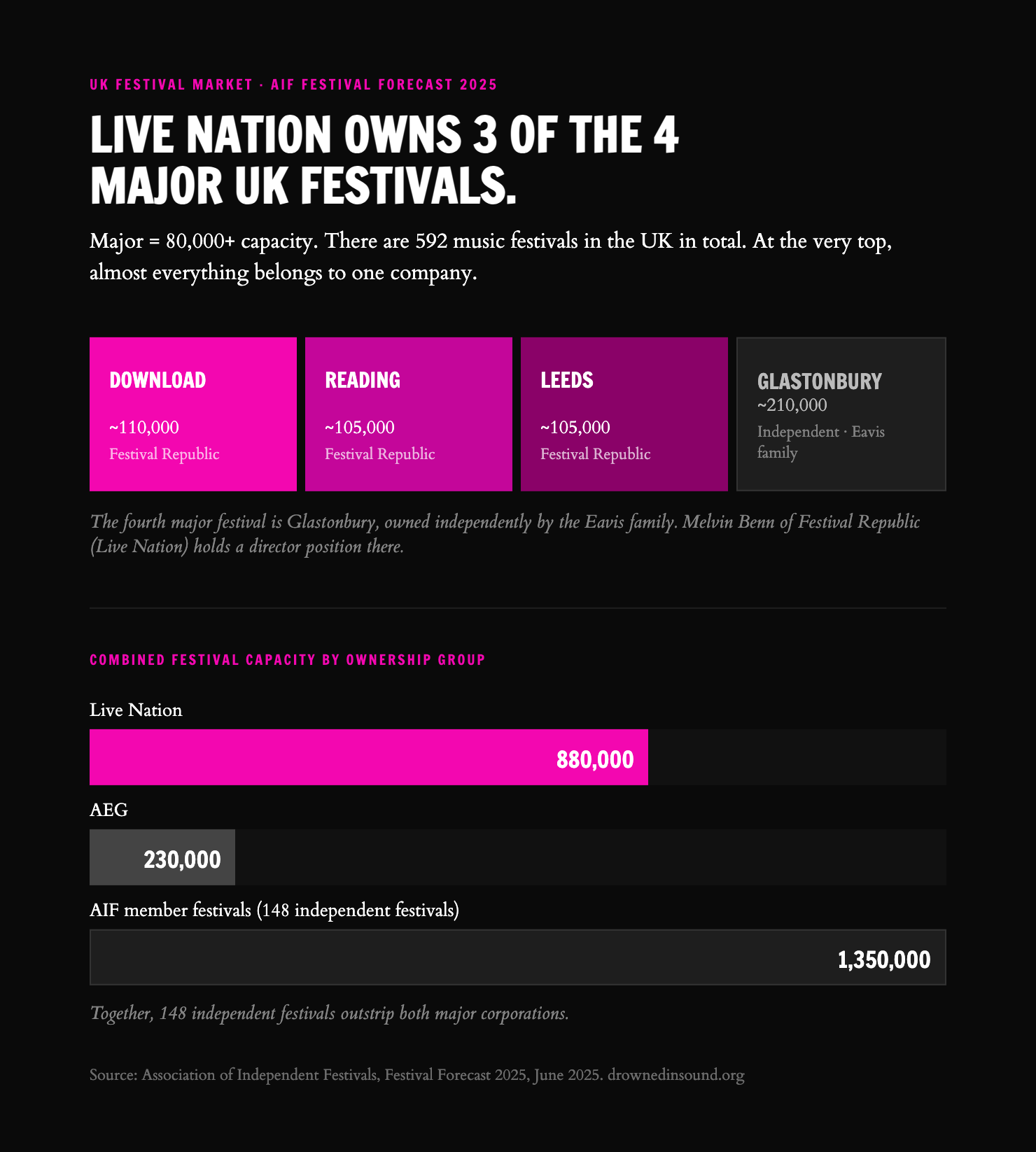
The Association of Independent Festivals research revealed that there are 592 music festivals in the UK.
However, of the four with a capacity above 80,000, Live Nation owns three. The fourth is Glastonbury, independently owned by the Eavis family, though Melvin Benn of Festival Republic holds a director position there.
By combined capacity, Live Nation's festival portfolio stands at around 880,000 attendees.
AEG, its nearest rival, totals 230,000 with events like BST in Hyde Park and All Points East (note: they also own The O2, The Eventim Apollo, and some other venues).
The 148 festivals that are part of the Association of Independent Festivals collectively outstrip both in terms of combined total of attendees, but that figure is the sum of 148 separate organisations rather than the holdings of two US-based corporations.¹⁵
Reacting to the House of Commons Business and Trade Committee's report on Instagram, John Rostron the CEO of Association of Independent Festivals surmised:
"There is still a long way to go. Now is the time for others to come forward. We will enjoy a long summer of independent, creative, vibrant music festivals whilst we also continue to gather evidence, data and all we need to prepare for work that is coming this Autumn. Together we can bring about the changes for a fairer, more equitable, more nourishing and more independent live music ecosystem."
Of course, Live Nation isn't the only corporate force reshaping the festival sector.
Superstruct Entertainment, founded by James Barton (who previously ran electronic music at Live Nation and founded Creamfields) and now backed by private equity firms KKR (notably the focus of last summer's protests that we reported on in this newsletter) and CVC Capital Partners, owns somewhere between 15 and 20 UK festivals including Boardmasters, Field Day and Kendal Calling.¹⁶
The rise of these new private equity firms and the potential break up of Live Nation and their affiliates is something to keep an eye on.
The role of private equity in music was something Sean discussed when he appeared on this podcast with Tori Tsui:
 CounterPunch Radio
Big business is big... so why does this all matter?
According to this submission to the committee, in 2025, for the first time, Swansea failed to secure any major tours despite viable venues and demand, with shows instead routed through Bristol and Cardiff, where Live Nation owns and promotes venues.
We're sure they will argue there was "reasons" for this. However, it will be interesting if the CMA finds similar stories in other cities.
What next?
Back in February 2025, Live Nation subsidiary Ticketmaster initially refused to attend a Committee evidence session, reportedly this was due to the then-ongoing Competition and Markets Authority (CMA) investigation, but they later accepted the invitation.
At the hearing, Andrew Parsons, Managing Director and Regional Vice President of Ticketmaster UK and Ireland, refuted the suggestion that Live Nation dominated the market. "That is not something I recognise," he said. "It is an incredibly competitive market within the UK."⁴
Following the committee's damning new report published over the bank holiday weekend, Live Nation UK had a similar line when they spoke to The Independent, suggesting that the document "misrepresents the UK live music industry by relying on inaccurate data and unsupported conclusions."⁹
DiS did a lot of digging and will be curious to see which data is incorrect. Let's hope we don't start getting into "alternative facts" territory...
The CMA, meanwhile, says it is "giving active and careful consideration to undertaking markets work in this area."¹⁰
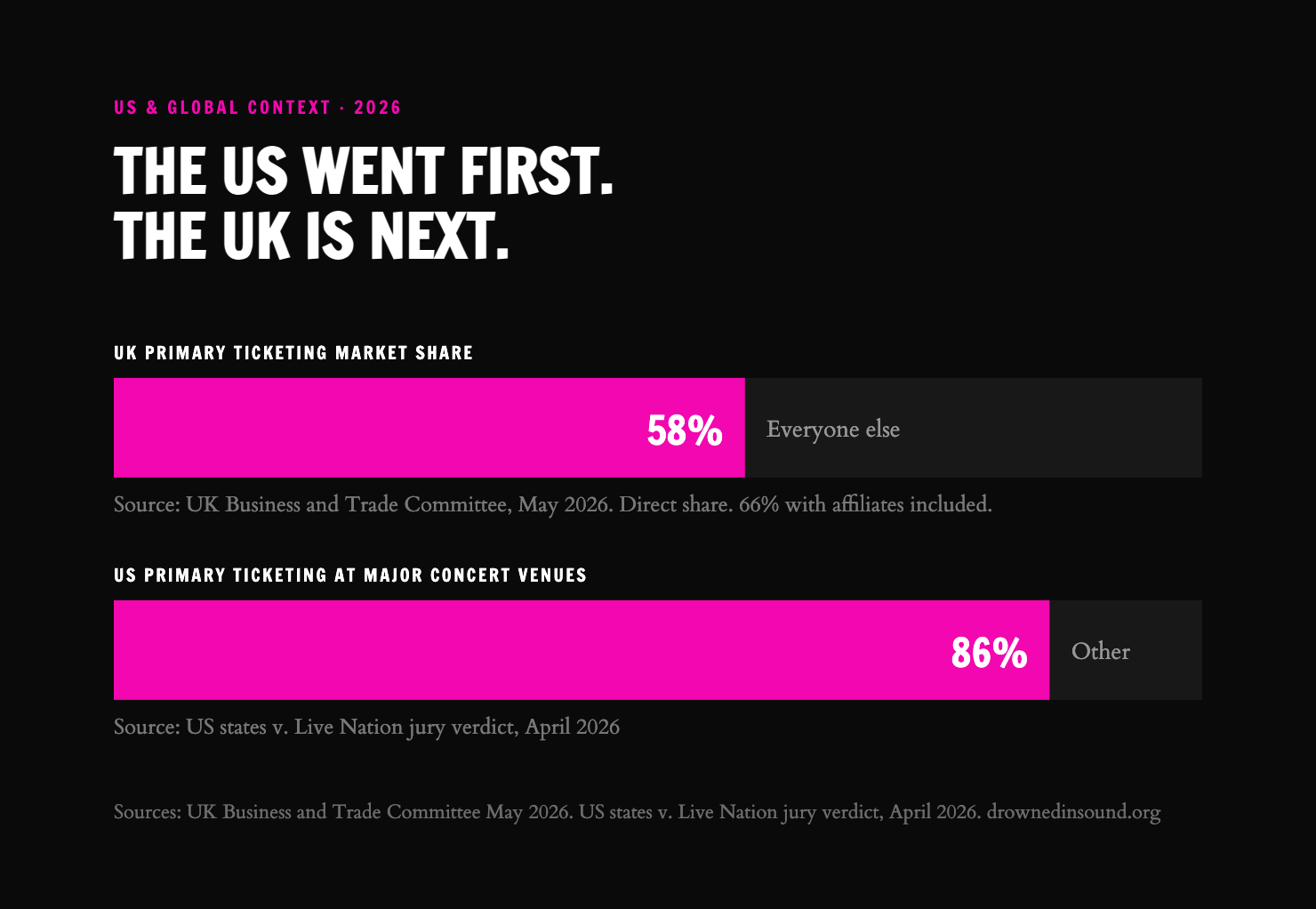
This isn't only a UK story, and it isn't a new one.
In 1994, Pearl Jam filed a Department of Justice antitrust complaint arguing that Ticketmaster's exclusive venue contracts made it impossible to tour without them. The DOJ investigated for 14 months and dropped the case.¹¹
As the timeline we've compiled suggests, the problem Pearl Jam identified 32 years ago didn't go away...
Much like in the UK, Live Nation got its merger with Ticketmaster approved in 2010. It was later found to have violated the conditions of that decree, but kept expanding for another decade before the Taylor Swift Eras Tour presale collapse in 2022 finally turned ticketing into a mass political event in the US.¹²
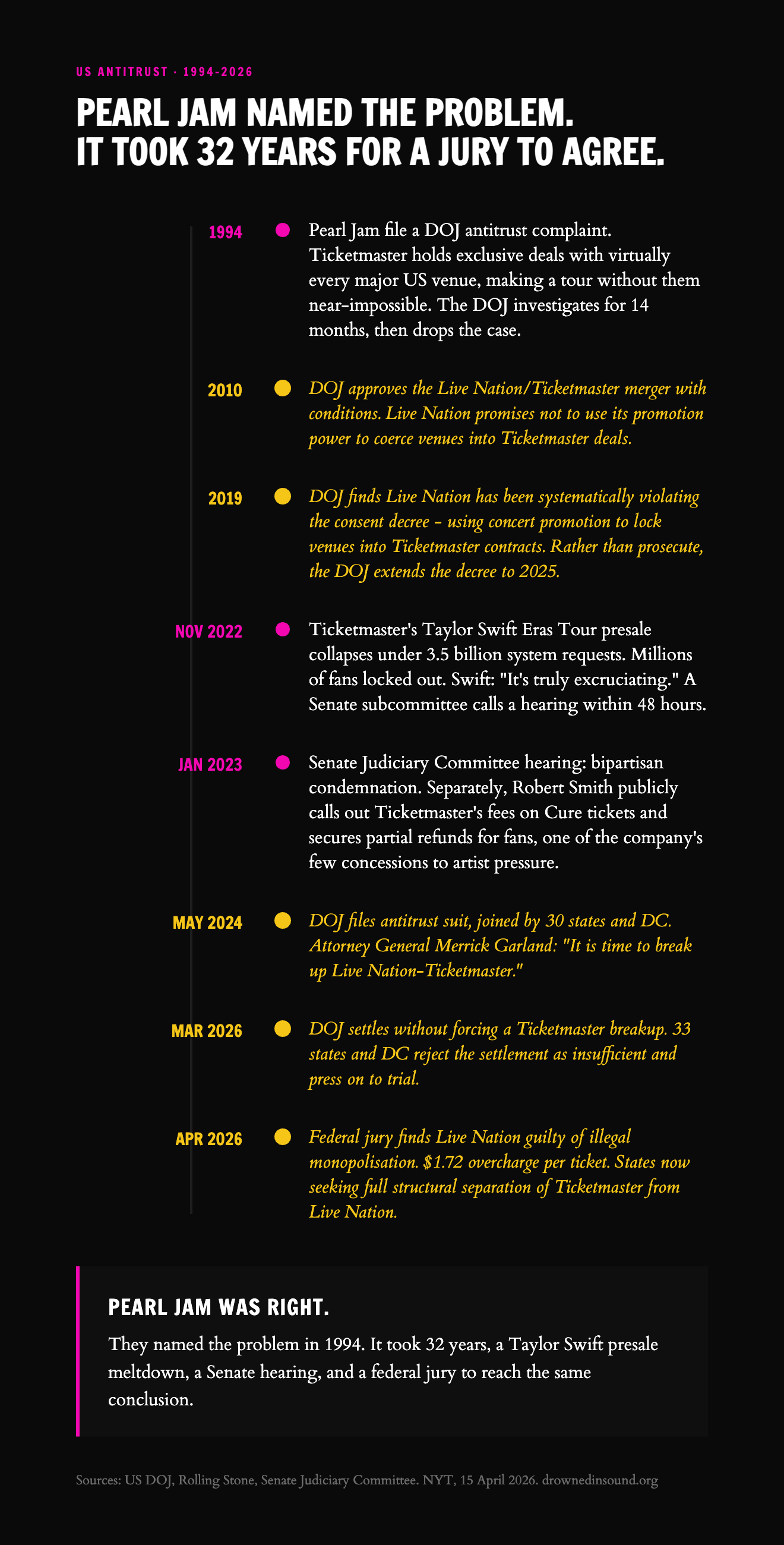
As you can see from the timeline, after all these years, things are moving quickly stateside.
The US Department of Justice filed an antitrust lawsuit against Live Nation in May 2024, joined by 30 states and the District of Columbia.¹³
The DOJ then settled in March 2026 without forcing a Ticketmaster breakup. Thirty-three states and DC rejected that settlement as insufficient and pressed on to trial.
On 15 April 2026, five weeks before the UK Committee published its report, a federal jury in the US found Live Nation guilty of illegal monopolisation and found Ticketmaster had overcharged consumers by $1.72 per ticket across 22 states. The states are now seeking the full separation of Ticketmaster from Live Nation, and the divestiture of Live Nation's amphitheatres.¹⁴
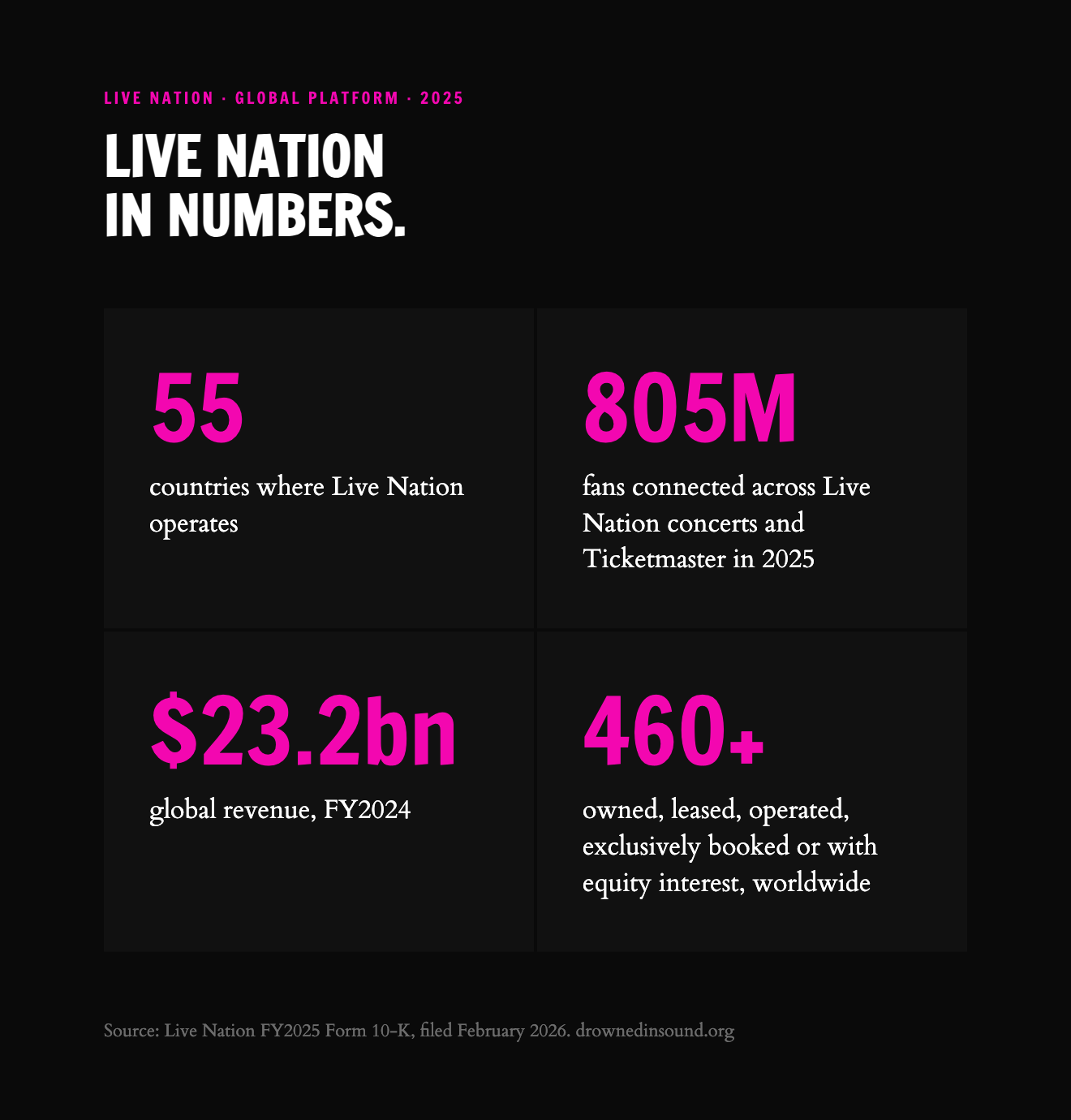
What the US states pursued through the courts, the UK Business and Trade Committee is now asking the Competition and Markets Authority to examine. The CMA has the powers, the Digital Markets, Competition and Consumers Act 2024 explicitly includes the ability to break up a business. The question is whether it uses them.
DiS will keep tracking this as the CMA decides whether to act in this newsletter and on our podcast.
Emma Wilkes
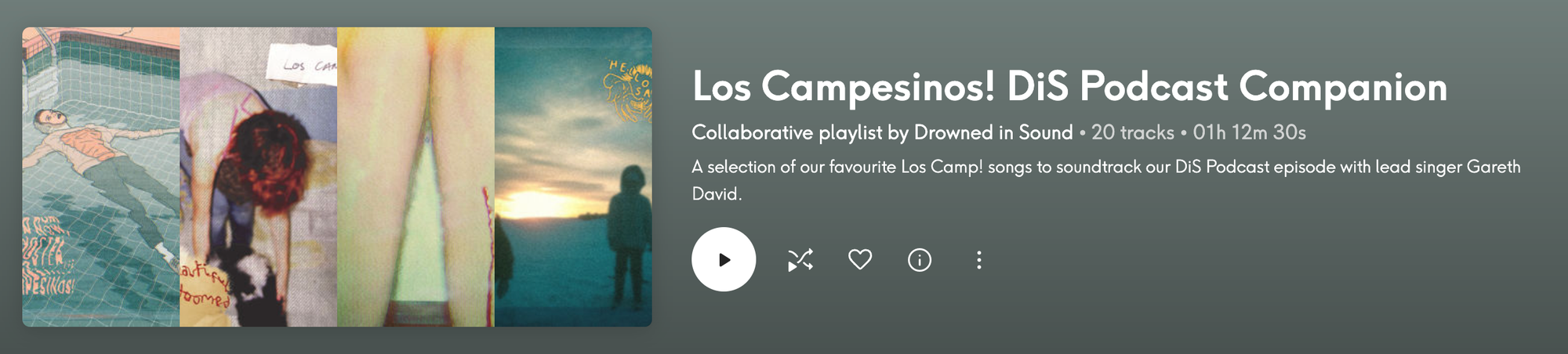
A selection of our favourite Los Camp! songs to soundtrack our latest episode of the DiS Podcast with lead singer Gareth David. Compiled by our new podcast co-host Helena Wadia.
RIP to Nightshift magazine
After 35 years in operation, free local music magazine Nightshift - based near me in Oxford - has published its final issue just days before founder Ronan Munro's 60th birthday.
"It's got harder and harder... delivery days are an absolute ordeal nowadays, financially it's always been up against it, and there's always that nagging feeling you're not really making a difference," Munro told the BBC.
Although a crowdfunder launched in 2021 to save Nightshift after the pandemic threatened its future reached its target in just four days, Munro issued a clarion call for the UK's music scene when he said how much more difficult the climate has become since. Indeed, despite the strength of Oxford's music scene in the past, it struggles to remain on major tour circuits.
"We get so many venues closing down, struggle to get people out to see new music when there's loads of tribute bands packing out big venues," he said.
"It gets a little bit demoralising, so I've been thinking about it for a while and in June I turn 60 and I thought that's a good time to do it.
"I don't want to be the weird old guy trying to tell people what to listen to".
Nightshift will get a proper send-off with a show at The Bullingdon this Sunday (31st May).
Keep your eye out for the launch of Fair Play magazine
Fair Play, the organisation championing working class creatives across a monthly newsletter and podcast, is gearing up to launch in print. Founded by musician Ynes, they've been counting down the days one by one till the magazine launches and fortunately. the pre-order sold out. All profits will go to charity and if you're based in or near Coventry, do hit up their launch event at The Tin on 12th June.
Correction: An earlier version of this article stated Live Nation owns AO Arena but it should had said operates shows at the Arena. It also stated that LN acquired DF Concerts but word has now been updated to reflect how it's stated in the committee report.
References
- UK Business and Trade Committee, Competition and market functioning in the UK live music industry, May 2026
- Which? analysis of Pollstar data, cited in Committee report, May 2026
- Dean James, co-founder of MAMA Group, quoted in Music Business Worldwide, May 2026
- Parliamentary transcript, Business and Trade Committee evidence sessions, 2025
- Companies House / Wikipedia, Hamsard Ltd PSC filings; Mean Fiddler Music Group acquisition, April 2005
- Companies House filings, both dated 16 April 2025. PSC02: Festival Republic Limited (02948536) — Person with Significant Control is UK Festival Holdings Limited (05646353), holding 75%+ shares, 75%+ voting rights, right to appoint or remove majority of board. PSC05: UK Festival Holdings Limited (05646353) — controlling entity confirmed as Live Nation (Music) UK Limited. Full ownership chain: Live Nation (Music) UK Ltd → UK Festival Holdings Ltd → Festival Republic Ltd.
- Music Venue Trust Annual Report 2025, published 20 January 2026 (also reported by The Guardian, BBC, The Standard, The Independent)
- [reference removed]
- Live Nation UK statement, The Independent, 24 May 2026
- CMA written evidence submission to the Business and Trade Committee, document LMI0023, para 3.6; reaffirmed by CMA spokesperson in press coverage, 24 May 2026
- Rolling Stone; DOJ case closure, 5 July 1995
- DOJ consent decree, January 2010; DOJ/Music Business Worldwide, December 2019 (consent decree extension)
- DOJ press release, 23 May 2024
- US states v. Live Nation, federal jury verdict, Southern District of New York, 15 April 2026
- Association of Independent Festivals, Festival Forecast 2025, June 2025. The 592 figure is AIF's first full count of the UK festival sector, combining 360 greenfield festivals and 232 single or multi-venue urban events. Includes events ranging from micro-festivals (under 1,000 capacity) to major camping festivals. No single official registry exists; counts vary between industry bodies.
- CVC Capital Partners press release on the Superstruct acquisition, 28 October 2024; IQ Magazine on KKR acquisition, June 2024. UK festival count is approximate; ownership structures range from outright control to operational partnerships and partial stakes.