
Guest post: New York-based music journalist Anagricel Duran on why Bad Bunny's Super Bowl performance meant so much to her and her fellow Latines.
On September 28th, 2025, it was announced that Puerto Rican superstar Bad Bunny would headline the NFL’s Super Bowl LX Halftime Show. Amid an already tense political climate and with a controversial figure currently leading the so-called “free world”, the decision to feature a global Latin artist at the country’s biggest sporting event drew swift backlash.
Bad Bunny - born Benito Antonio Martínez Ocasio – became a target of criticism from conservative commentators and media figures, prompting Turning Point USA to announce its own “All-American Halftime Show” in protest.
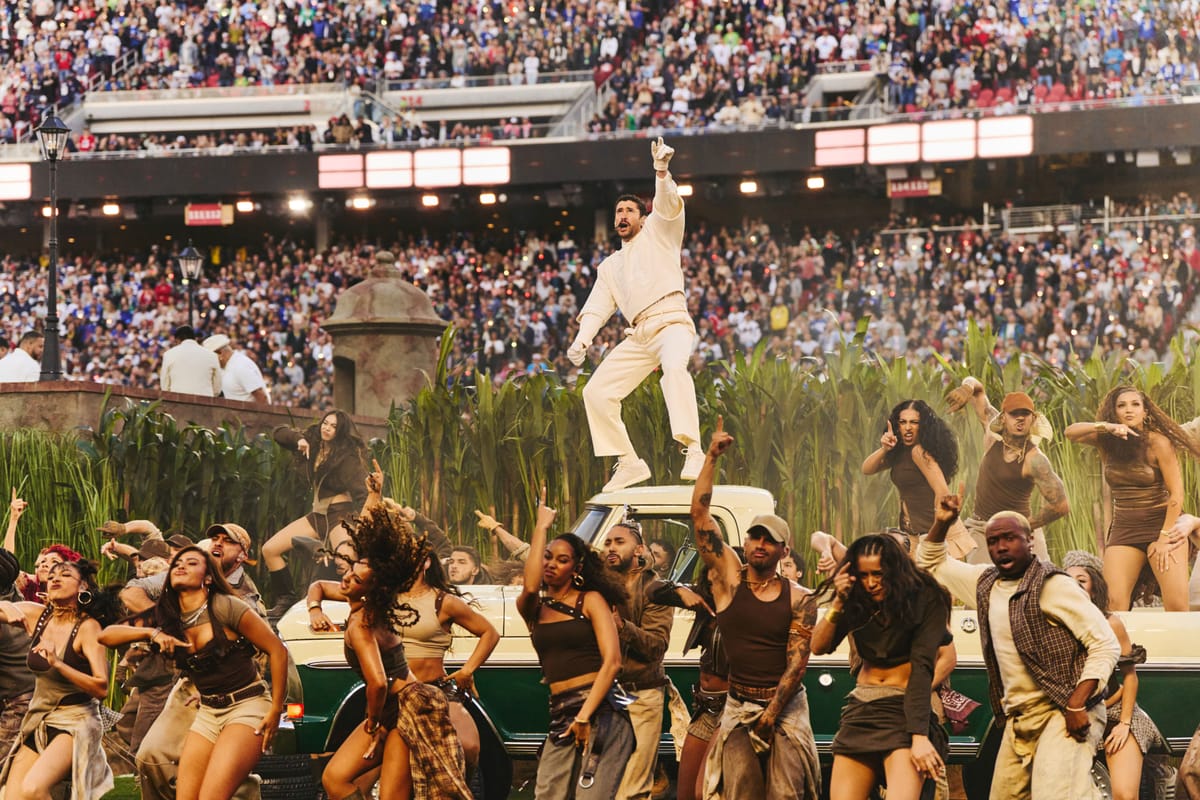
However, Bad Bunny’s performance this past Sunday (February 8th) was not simply another pop culture moment but a historic celebration of Latine identity and culture on one of the world’s biggest stages, marking a massive milestone for representation in mainstream American culture.
Since June 2025, U.S. Immigration and Customs Enforcement (ICE) operations have significantly escalated under the Trump Administration. This was marked by increased detention, National Guard deployment in various states and high-profile raids. Most notably, “Operation Metro Surge” in Minnesota in early December, which allowed thousands of federal agents to arrest immigrants in the state.
These agents have gone on to kill two civilians – Renée Good and Alex Pretti – and have continued to racially profile people and arrest not only undocumented immigrants, but also refugees and others with legal statuses, tribal citizens and permanent residents. These raids have been met with public protest, responses by advocacy organizations and opposition from local officers.
With ICE raids being one of the constant focal points of our daily news in the US, Benito’s performance served as a break from all of the heartbreak.
A little background on me for one second: I am a first-generation American, born and raised in Queens, New York, to two hardworking and dedicated immigrants from the Dominican Republic. My love for music was passed down from my father, who would blast all the bachata, merengue, salsa and perico ripiado from his childhood as well as music from who he considered to be “the greats” - Queen, The Eagles, Boyz II Men, Simply Red, Whitney Houston and more.
I was elated to see how excited Puerto Ricans and other Latines were prepping for this moment by hosting watch parties, meeting up at local bars or even certain Brooklyn music venues to be united for this moment. Sports fans or not, everyone in this community needed a moment to feel celebrated and represented, especially during a time where it is not safe to speak your native language or for some people just live a normal life due to the constant threat of being taken by ICE.
The opening scene of the performance was powerful. A shot of a man dressed in white wearing a traditional Pava hat holding a guitar infront of a sugar cane plantation who says: “Qué rico es ser latino,” which translates to “How wonderful it is to be Latino.” That phrase alone was something that the community needed to hear.
There was so much symbolism within every detail. I won't get into all of them but my fellow colleague, Tatiana Tenreyro (music journalist and editor in chief of Antics magazine) wrote a lovely essay decoding Bad Bunny’s performance for the LA Times.
However, here are a few that stood out to me personally:
The sugar cane fields were a nod to all the enslaved people from the Caribbean Islands who were forced to harvest the plants after Europeans made their way across the Atlantic. Growing up, my grandfather and uncles would bring home sugar cane in DR and peel and cut it up into pieces as a treat for me and my siblings. The sweet nectar of our roots and ancestors.
A traditional tiered cake during the wedding scene right before Lady Gaga is revealed as a guest singer for a salsa rendition of ‘Die With A Smile’, is something that I’ve seen in various photos from my mother’s childhood photos. A pair of children dancing salsa together before panning over to another child laying across three chairs assembled as a makeshift bed, something I and many of my fellow Latinx people have experienced during times when you wanted to go home as a kid but your parents wanted to keep dancing and celebrating into the early hours of the morning.
“Baila sin miedo!,” Bentio says which translates to “dance without fear,” something my elders would say to me after grabbing me to join them in a salsa or bachata dance as a way to learn rhythm and our traditional dance even thought I’d be shy and embarrassed from the cheers and encouragement. A set built to resemble a Bodega – our version of an off-license/corner shop and a place where my father began to work when he arrived to New York in the 80s.
A cameo made by María Antonia “Toñita” Cay, the owner of the famous Caribbean social club in Williamsburg, Brooklyn which is one of the last standing authentic Puerto Rican social clubs where the Puerto Rican and Latine community are nurtured and celebrated.
But of course, the most powerful moment of all, is when Bentio declares “God Bless America” and proceeds to name every single country that makes up the Americas before flashing an American football with the words “Together, we are America” and proceeding to say “Segumos Aquí” meaning “We are here” front of a screen that read “The only thing more powerful than hate is love,” a quote from his speech at this year's Grammys where he won the golden gramophone for Best Muscia Urbana Album and made history as the first artist to win Album of the Year with an entirely Spanish-language for ‘DeBÍ TiRAR MáS FOToS’.
Yes, I sobbed and honestly, I am still crying while typing this up and will probably continue to cry every time I watch this performance because, for me personally, this is the first time I have seen my culture on what is essentially the US’ biggest stage and got to see it represented truthfully. Moments that seemed very mundane and normal – ie, sleeping on chairs at a family party, dancing salsa with my elders, eating sugar cane and having fresh coconut water – on the big screen so that everyone could see the unity and community we as Latines are fortunate to be a part of.
ESPN reporter John Sutcliffe said it best: While reporting on the grounds, Sutcliffe – with tears of pride and happiness – shared “Honestly, it was very emotional - the message that [Bad] Bunny sent. Whether you like his music or not, it was done with love, with culture, with affection, you know? In a world where suddenly everyone seems to be fighting, it's worth recognizing that Lady Gaga was there, that Ricky Martin also showed up.
“And wherever you are today - Mexico, Argentina, Colombia, Chile - wherever you may be: it's okay to have a tear in your eye and feel proud that Benito sang in Spanish at the most important party in America. Long live Bad Bunny!"
"HAY QUE SENTIRSE ORGULLOSO, BENITO LE CANTÓ EN ESPAÑOL A LA FIESTA MÁS IMPORTANTE DE LOS AMERICANOS" 🥺
— ESPN.com.mx (@ESPNmx) February 9, 2026
John Sutcliffe se puso emotivo por el mensaje de Bad Bunny en su show durante el halftime del Super Bowl LX.
Disfruta del Super Bowl x ESPN y #DisneyPlus Premium. 📺 pic.twitter.com/x8hZWhzPCD
Of course, the performance wasn’t praised by everyone. It triggered backlash from MAGA figures such as Former Fox News host Megyn Kelly and Trump’s 2024 campaign manager. Trump himself took to social media to blast the performance sharing that it was “one of the worst, EVER! It makes no sense,” as well as complaining that “Nobody understands a word this guy is saying, and the dancing is disgusting, especially for young children that are watching from throughout the U.S.A.”
Drowned In Sound’s very own Sean Adams actually fact checked Trump’s comments, revealing that approximately one in five Americans (60 million) understood the lyrics of Bad Bunny's halftime show, thanks to the dominance of Spanish as the second most spoken language in the US. Globally, one in twelve people (650 million) understood it as Spanish ranks fourth in number of native speakers (520 million), but is second (or third, depending on the statistics) in total number of speakers, behind only English and Mandarin.
Also, very interesting that Trump would be commenting on the well-being of children…. Very interesting.
All in all, Benito’s performance has made history as the most-watched halftime with over 135 million viewers and as the first solo male Latine artist to headline and perform almost entirely in Spanish. His message was very clear, unity and love will always overpower hate. God bless America.
Anagricel Duran is a freelance music, entertainment and culture journalist based in New York City. Her work has been featured in publications such as NME, CREEM, MARVIN, Grammys.com, Something About Rocks and more. She also publishes her writing via her newsletter, The Soft Chaos.